Quick Answer
The District line is one of the oldest and busiest lines on the London Underground network. Identified by its green colour on the Tube map, it serves 60 stations across West, Central, and East London, running from Upminster in the east to Ealing Broadway, Richmond, Wimbledon, and Kensington (Olympia) in the west. Opened in 1868 as part of the Metropolitan District Railway, it carries millions of passengers every year and plays a vital role in London’s public transport system. For more insights read here:- nancy sorrell and olga koch.
- Quick Answer
- District Line Key Facts
- What Is the District Line?
- History of the District Line
- District Line Route
- Why the District Line Is Important
- Major District Line Branches
- Upminster to Ealing Broadway
- Upminster to Richmond
- Upminster to Wimbledon
- Upminster to Kensington (Olympia)
- Major District Line Stations
- District Line Trains
- Service Frequency and Operating Hours
- Accessibility on the District Line
- Major Interchanges
- Interesting Facts About the District Line
- Future Improvements to the District Line
- Travel Tips for Using the District Line
- Check Your Branch Before Boarding
- Avoid Peak Hours When Possible
- Use Contactless or Oyster
- Plan Connections in Advance
- Follow Live Service Updates
- Frequently Asked Questions
- Q1. What is the District line?
- Q2. How many stations are on the District line?
- Q3. Why is the District line shown in green?
- Q4. Does the District line run all night?
- Q5. Which attractions can you visit using the District line?
- Conclusion
District Line Key Facts
| Information | Details |
|---|---|
| Line Name | District line |
| Operator | Transport for London (TfL) |
| Colour on Tube Map | Green |
| Opened | 24 December 1868 |
| Number of Stations | 60 |
| Route Length | Approximately 64 km (40 miles) |
| Eastern Terminus | Upminster |
| Western Branches | Ealing Broadway, Richmond, Wimbledon, Kensington (Olympia) |
| Type | Sub-surface London Underground line |
| Rolling Stock | S7 Stock |
| Daily Purpose | Commuter and passenger transport |
What Is the District Line?
The District line is a major London Underground route operated by Transport for London (TfL). It connects residential neighbourhoods, business districts, tourist attractions, and important transport hubs across the capital.
Unlike many Underground lines that follow a single route, the District line has several western branches, making it one of the most extensive lines on the Tube network. Its trains travel through central London before splitting towards Richmond, Ealing Broadway, Wimbledon, and Kensington (Olympia), while all regular services continue east towards Upminster.
Because it serves so many destinations, the District line is used by commuters, students, tourists, and business travellers every day. It also provides convenient connections with National Rail services, the Elizabeth line, the Circle line, the Piccadilly line, and several other Underground routes.
History of the District Line
The history of the District line dates back to the nineteenth century, when London was expanding rapidly and the demand for efficient public transport continued to grow.
The line originally opened on 24 December 1868 as part of the Metropolitan District Railway, operating between South Kensington and Westminster. It was created to help complete London’s famous Inner Circle railway, which later evolved into today’s Circle line.
During its early years, the railway gradually expanded westwards and eastwards, connecting more districts of the capital. New stations and branches were added over several decades, transforming the District Railway into one of London’s most important transport corridors.
In the early twentieth century, the railway became part of the Underground Electric Railways Company of London, and the line was progressively electrified. Electric trains replaced steam locomotives, making journeys cleaner, faster, and more comfortable for passengers.
Following the creation of London Transport in 1933, the District line became an official part of the unified London Underground network. Since then, it has continued to modernise while preserving its historic role within the capital’s transport system.
District Line Route
One of the defining characteristics of the District line is its complex network of branches.
Unlike lines that operate between just two termini, the District line divides into multiple western routes after passing through central London. This allows passengers to travel directly to several major destinations without changing trains.
The main eastern terminus is Upminster, located in the London Borough of Havering. From there, trains travel west through East London before reaching central London stations such as Tower Hill, Monument, Blackfriars, Westminster, Victoria, and South Kensington.
After passing through Earl’s Court, services branch towards four different destinations:
- Ealing Broadway
- Richmond
- Wimbledon
- Kensington (Olympia) (limited service)
This branching layout makes the District line one of the most flexible routes on the London Underground and an essential part of daily travel across the city.
Why the District Line Is Important
The District line is much more than a commuter railway. It connects many of London’s most famous attractions, business centres, and residential communities.
Passengers regularly use the line to reach destinations such as:
- Westminster
- Victoria
- South Kensington
- Tower Hill
- Kew Gardens
- Wimbledon
- Richmond
- Earl’s Court
The line also provides convenient interchange opportunities with almost every major Underground route, National Rail services, and the Elizabeth line, making it one of the most interconnected transport corridors in London.
Thanks to its extensive coverage and frequent services, the District line continues to play a vital role in supporting London’s economy, tourism, and everyday travel.
Major District Line Branches
One of the features that makes the District line unique is its four western branches. After trains pass through Earl’s Court, they continue towards different destinations, allowing passengers to travel across a large part of Greater London without changing lines.
Upminster to Ealing Broadway
This branch connects East London with West London and is one of the busiest sections of the District line. It serves residential areas, shopping districts, and business centres, making it popular with both commuters and visitors.
Passengers travelling to Ealing Broadway can also connect with the Elizabeth line, Great Western Railway, and other local rail services.
Upminster to Richmond
The Richmond branch provides direct access to southwest London and is especially popular with commuters travelling to Richmond’s town centre and riverside attractions.
Richmond is also an important interchange for South Western Railway, the London Overground, and local bus services.
Upminster to Wimbledon
The Wimbledon branch serves densely populated areas of southwest London and offers convenient access to one of London’s busiest National Rail stations.
Many passengers use this route during the annual Wimbledon Tennis Championships, when demand increases significantly.
Upminster to Kensington (Olympia)
The Kensington (Olympia) service operates less frequently than the other branches.
Although it has limited daily services, it provides useful connections for visitors attending exhibitions, conferences, concerts, and sporting events at Kensington Olympia exhibition centre.
Major District Line Stations
The District line serves 60 stations, many of which are among London’s busiest transport hubs.
Some of the most important stations include:
| Station | Why It’s Important |
|---|---|
| Upminster | Eastern terminus |
| Barking | National Rail interchange |
| Tower Hill | Near the Tower of London |
| Monument | Financial district access |
| Blackfriars | Thameslink connections |
| Westminster | Houses of Parliament and Big Ben |
| Victoria | National Rail and Gatwick Express |
| South Kensington | Museums and universities |
| Earl’s Court | Main branching point |
| Richmond | National Rail and London Overground |
| Wimbledon | National Rail and Tramlink |
| Ealing Broadway | Elizabeth line interchange |
These stations make the District line one of the best Underground routes for reaching many of London’s most famous landmarks and transport connections.
District Line Trains
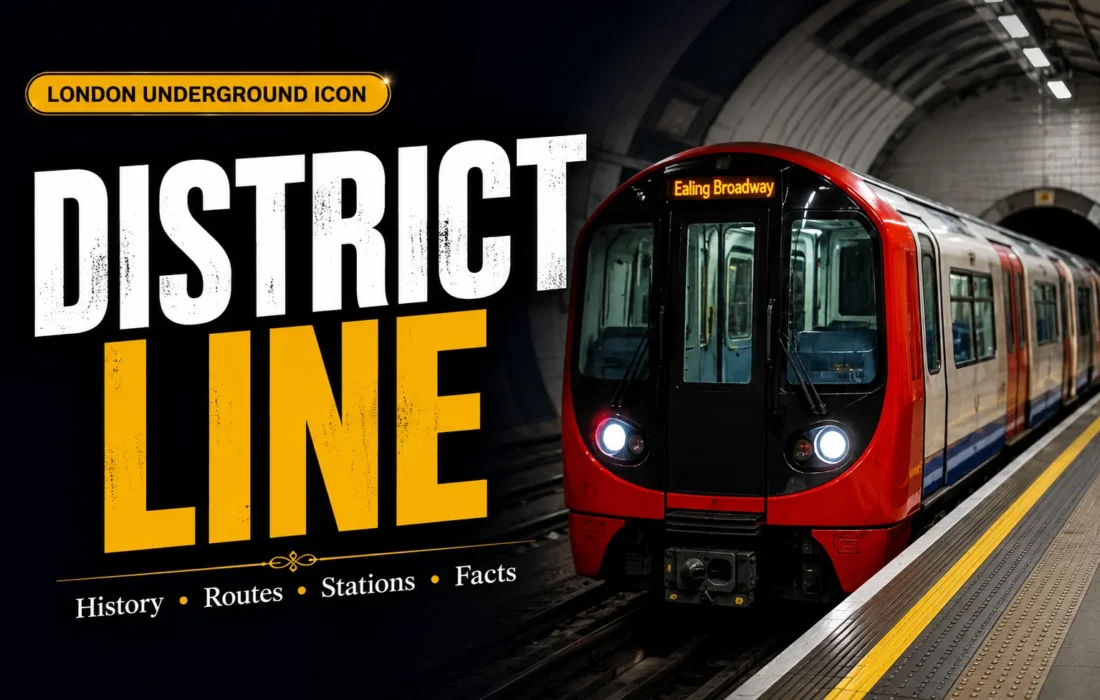
The District line is operated using S7 Stock trains, which were introduced as part of Transport for London’s modernisation programme.
These trains replaced the older D78 Stock fleet and brought significant improvements in comfort, accessibility, and reliability.
Some key features of the S7 Stock include:
- Air-conditioned carriages
- Walk-through interiors
- CCTV throughout the train
- Digital passenger information displays
- Dedicated wheelchair spaces
- Wider doors for faster boarding
- Improved energy efficiency
The modern fleet has made journeys quieter, smoother, and more comfortable while increasing capacity during busy travel periods. also explore:- dick and dom.
Service Frequency and Operating Hours
District line services generally begin early in the morning and continue until shortly after midnight, although exact times vary depending on the station and branch.
During weekday peak periods, trains typically run every few minutes through the central section, while services on individual branches may operate less frequently.
On Friday and Saturday nights, a Night Tube service runs on the District line between Upminster and Earl’s Court. From Earl’s Court, trains continue to Wimbledon and Richmond. There is no Night Tube service to Ealing Broadway or Kensington (Olympia).
Passengers can check live departure information through the official Transport for London journey planner before travelling.
Accessibility on the District Line
Transport for London has continued improving accessibility across the Underground network, and many District line stations now offer step-free access.
Accessibility features include:
- Step-free access at selected stations
- Audio and visual passenger announcements
- Priority seating
- Wheelchair spaces on every S7 train
- Staff assistance at larger stations
- Tactile paving for visually impaired passengers
While not every station is fully accessible due to the railway’s historic infrastructure, TfL continues upgrading stations where possible.
Major Interchanges
The District line connects with almost every major transport network in London, making it one of the most convenient Underground lines for changing trains.
Important interchange stations include:
| Station | Connections |
|---|---|
| Westminster | Jubilee Line |
| Victoria | Victoria Line, National Rail, Gatwick Express |
| South Kensington | Circle, Piccadilly |
| Blackfriars | Thameslink |
| Monument | Circle, Northern via Bank, DLR (nearby) |
| Earl’s Court | Piccadilly Line |
| Ealing Broadway | Elizabeth Line, Great Western Railway |
| Richmond | London Overground, National Rail |
| Wimbledon | National Rail, Tramlink |
These connections allow passengers to travel easily across London and beyond using a single integrated transport network.
Interesting Facts About the District Line
The District line has a long and fascinating history. Here are some interesting facts:
- It opened in 1868, making it one of the oldest Underground lines.
- The line is shown in green on the official London Underground map.
- It serves 60 stations, more than many other Tube lines.
- The route stretches for approximately 64 kilometres (40 miles).
- It uses modern S7 Stock trains with air conditioning.
- The District line shares tracks with the Circle, Piccadilly, and Hammersmith & City lines in several locations.
- It is one of the few Underground lines with multiple western branches.
- Millions of passenger journeys are made on the District line every year.
Future Improvements to the District Line
Transport for London (TfL) continues to invest in improving the District line through infrastructure upgrades, modern signalling, and station accessibility projects. These improvements aim to increase reliability, reduce delays, and provide a better experience for millions of passengers.
One of the biggest long-term improvements has been the introduction of modern S7 Stock trains and the gradual rollout of advanced signalling technology across the sub-surface railway. The new signalling system allows trains to run closer together while maintaining high safety standards, helping to increase capacity and reduce waiting times.
In 2026, TfL began rolling out 4G and 5G mobile coverage in District line tunnels between Barking and West Ham, with full coverage planned across the line by the end of 2026.
TfL also continues to improve station accessibility by adding lifts, step-free routes, upgraded platforms, and clearer passenger information displays where possible. Although some historic stations present engineering challenges, accessibility remains a key priority for future investment.
As London’s population continues to grow, the District line is expected to remain one of the capital’s most important transport routes, supporting commuters, tourists, and businesses across the city.
Travel Tips for Using the District Line
Whether you’re a daily commuter or visiting London for the first time, a few simple tips can make travelling on the District line much easier.
Check Your Branch Before Boarding
Because the District line has multiple western branches, not every train travels to the same destination. Always check the train’s destination displayed on platform screens and onboard signs before boarding.
Avoid Peak Hours When Possible
Weekday mornings and evenings are the busiest times, especially through central London stations such as Victoria, Westminster, South Kensington, and Earl’s Court. Travelling outside peak hours often means quieter trains and shorter waiting times.
Use Contactless or Oyster
The easiest way to pay for travel is with a contactless bank card, mobile payment device, or Oyster card. These methods automatically calculate the correct fare and are generally more convenient than purchasing paper tickets.
Plan Connections in Advance
The District line offers excellent connections with National Rail services, the Elizabeth line, London Overground, Docklands Light Railway (DLR), and many other Underground lines. Using a journey planner before travelling can help you choose the fastest route and avoid unnecessary changes.
Follow Live Service Updates
Engineering work, planned maintenance, or unexpected incidents may occasionally affect services. Checking live travel updates before leaving home can help you avoid delays and select alternative routes if necessary.
Frequently Asked Questions
Q1. What is the District line?
Answer: The District line is a London Underground route operated by Transport for London. It runs between Upminster in East London and the western branches serving Ealing Broadway, Richmond, Wimbledon, and Kensington (Olympia), connecting 60 stations across the capital.
Q2. How many stations are on the District line?
Answer: The District line serves 60 stations, making it one of the largest lines on the London Underground network. It connects major tourist attractions, business districts, residential neighbourhoods, and important transport interchanges.
Q3. Why is the District line shown in green?
Answer: Each London Underground line has its own colour for easier navigation. The District line has been represented by green on the official Tube map for many years, making it easy for passengers to identify when planning their journeys.
Q4. Does the District line run all night?
Answer: Parts of the District line participate in London’s Night Tube service on Friday and Saturday nights. However, overnight services operate only on selected sections, so passengers should check the latest timetable before travelling.
Q5. Which attractions can you visit using the District line?
Answer: The District line provides easy access to many of London’s most popular attractions, including Westminster Abbey, the Houses of Parliament, Big Ben, the Natural History Museum, the Victoria and Albert Museum, the Tower of London, Kew Gardens, and Wimbledon.
Conclusion
The District line is one of the most historic and versatile routes on the London Underground, serving millions of passengers each year across 60 stations. Since opening in 1868, it has grown into a vital transport link connecting East, Central, and West London through its multiple branches and extensive interchange opportunities.
With modern S7 Stock trains, ongoing signalling upgrades, and continued investment in accessibility, the line remains well equipped to meet the needs of today’s travellers while preserving its rich heritage. Whether you’re commuting to work, exploring London’s famous landmarks, or connecting with other rail services, the District line continues to play an essential role in keeping the city moving.